Golf Injuries · Cedar Park, TX
Golf Specific Conditions
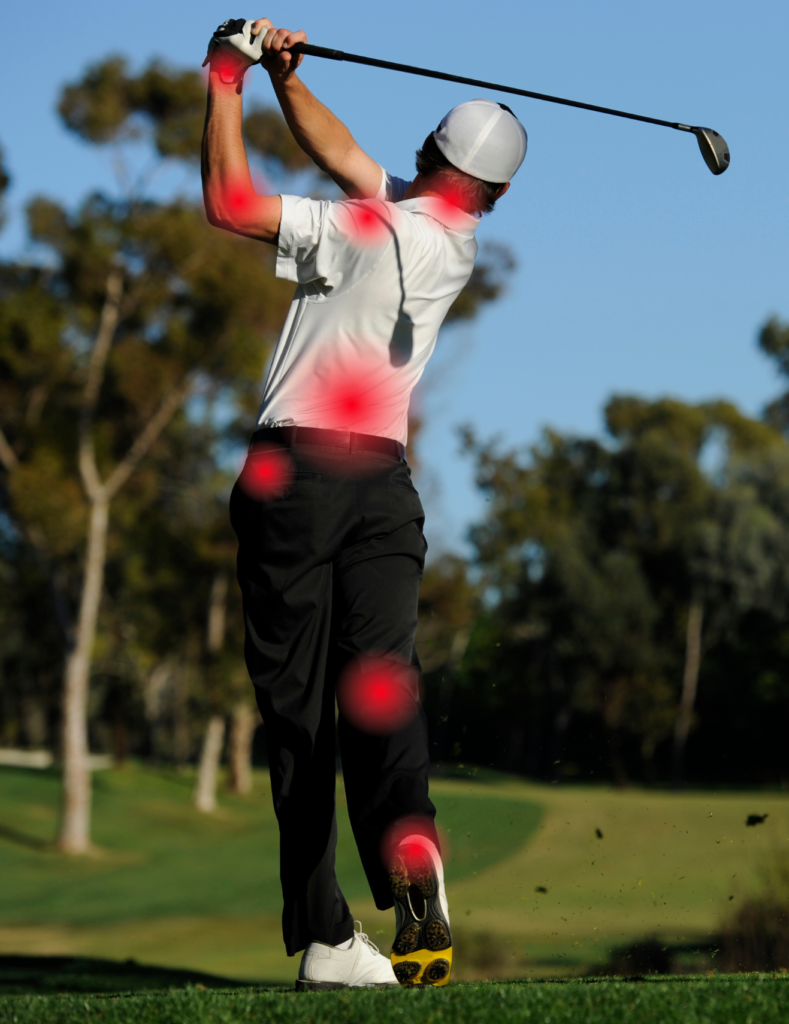
Golf may not be a contact sport, but the repetitive motion, high-speed swings, and long hours on the course take a toll on your body. Whether it’s nagging low back pain, a stiff shoulder, or golfer’s elbow, these injuries don’t just hurt—they can wreck your game.
Root cause focused · Non-invasive · Cedar Park, TX
Does This Sound Like You?
If Any of These Feel Familiar — You're in the Right Place.
Golf injuries don’t happen because you’re unlucky or getting older. They happen because the swing is a full-body movement — and when any part of that chain breaks down, something else compensates. That compensation is where injury comes from.
Most golfers play through it. They adjust their grip, shorten their backswing, or take a few weeks off. And then they’re right back where they started.
The problem isn’t that you’re playing too much. It’s that the underlying restriction driving the injury has never been found and fixed.
Common Golf Complaints
- Low back pain during or after your round — especially through rotation
- Shoulder pain that limits your backswing or follow-through
- Elbow pain — inside or outside — that flares when you grip or swing
- Wrist or hand pain that affects your grip pressure and contact
- Hip tightness that limits your rotation and forces a compensated swing
- Heel or foot pain that makes walking 18 holes something you dread
- You've been told to rest and come back next season — and you're not willing to accept that
Here’s What Most People Get Wrong
Your Swing Isn't the Problem. Your Body Is.
Most golfers assume their swing faults are a technique problem. So they take more lessons. They watch more YouTube. They tinker with their grip and stance.
But many swing faults aren’t technique problems — they’re physical limitations your body is working around. An early extension. A reverse spine angle. A loss of posture. These aren’t habits. They’re compensations for restrictions in your hips, thoracic spine, or shoulders that your body is trying to protect.
Fix the restriction and the swing fault often disappears — without a single lesson.
Our goal is always to reduce your pain — directly and as quickly as possible. But pain relief alone isn’t enough if the physical limitation driving both your pain and your swing fault hasn’t been addressed. That’s the difference between feeling better for a few weeks and actually performing better for the long term.
Every golfer we see gets a golf-specific assessment that connects what we find in your body to what’s happening in your swing. Not just where you hurt — but why your body is moving the way it is.
The plan addresses both. That’s how you play better and hurt less — at the same time.
golf performance certifications
Built for the Golfer Who Takes Their Game Seriously.
Trained and certified in the leading golf performance and movement assessment systems.





Conditions We Treat
Golf Affects the Entire Body. We Treat All of It.
You may have been given a specific diagnosis — or you may just know that something hurts when you play. Either way, we treat the underlying mechanics, not just the label.
Injured Area
Neck/Cervical Spine
Most Common Neck Injuries in Golf
- Sprain/Strain – Levator Scapula Strain
- Facet Syndrome – Cervical Facet Joints
- Disc Bulge or Herniation – C5-C6 most common
- Spinal Stenosis – Canal or IVF Narrowing
- Degenerative Joint/Disc Disease – Arthritis
- Thoracic Outlet Syndrome
Swing Characteristics/Faults
- Early Extension
- C-Posture
- Reverse Spine Angle
- Hanging Back
- Keeping Your Head Down
Back/Lumbar & Thoracic Spine
Most Common Back Injuries in Golf
- Sprain/Strain – Muscles, SI Joint, Soft Tissues
- Facet Syndrome – Lumbar Facet Joints
- Disc Pathology
Spinal Stenosis – Canal or IVF Narrowing - Degenerative Joint/Disc Disease – Arthritis
- Spondylolisthesis
Swing Characteristics/Faults
- Reverse Spine Angle
- S-Posture
- Excessive Spine Rotation
- Excessive Side Bend
- Early Extension
- Hanging Back / Restricted Right Leg Follow-Through
Shoulder, Elbow, Wrist
Most Common Shoulder Injuries in Golf
- Rotator Cuff Tendonitis
- Bicipital Tendonitis
- Impingement
- Labrum Tears (SLAP Lesions)
- Anterior Laxity
- Frozen Shoulder
Most Common Elbow Injuries in Golf
- Lateral Epicondylitis (Tennis Elbow)
- Medial Epicondylitis (Golfer’s Elbow)
- Pronator Syndrome
- Ulnar Collateral Ligament Injury
- Medial Epicondyle Apophysitis
- Ulnar Neuritis
- Radicapetellar Injury
Most Common Hand/Wrist Injuries in Golf
- Sprain / Strain
- TFCC Tear
- Carpal Instability
- Carpal Tunnel Syndrome
- De Quervain’s Syndrome
- Hamate Fracture
- Basal Joint Arthritis
- Trigger Finger
Swing Characteristics/Faults
- Steep Swing Plane
- Fat Divots
- Casting
- Trail Forearm Vertical
- Excessive Pronation on Backswing
- Limited Follow-Through
- Poor Use of the Lower Body
- Chicken Wing
- Hitting Off of Hard Surfaces
- Sudden Increase in the Volume of Practice
- Alteration of the Grip
- Death Grip
- Palm Grip
- Wrong Size Grips
- Wrong Club or Shaft Weight
- Wrong Shaft Type or Flex
- Scooping/Casting
- Over the Top
Hip, Knee, Foot
Most Common Hip Injuries in Golf
- Trochanteric bursitis or IT band
- Osteoarthritis
- Impingement
- Labral tear
Most Common Knee Injuries in Golf
- Ligament Injury – ACL, PCL, MCL, LCL
- Tendinitis – Patellar, Quadricep, Hamstring
- Arthritis – Joint Mouse, Cartilage Degeneration, Articular Cartilage Damage
- Meniscus Injury – Medial & Lateral Tears
- Patellofemoral Pain – Tracking, Imbalances
Swing Characteristics/Faults
- Square Feet
- Stance Width Variations
- Right Hip High (Right-Handed Player)
- “S”- Posture
- Sway
- Slide
- Hanging Back
- Straightening the Trail Leg
How We Treat It
A Golf-Specific Plan. Not a Generic Protocol.
Every golfer gets an assessment that looks at the body the way the game demands it. What we find determines what we do.
01
Golf-Specific Movement Assessment
Every golfer we see receives a TPI-based movement screen as part of their evaluation — identifying the physical limitations that are affecting your swing, contributing to your pain, or setting you up for injury. We connect what we find in your body directly to what’s happening in your game.
02
Restore Proper Mechanics
Chiropractic adjustments and myofascial therapy — including IASTM — to restore the joint mobility and soft tissue function your swing requires. Targeted to what your assessment reveals, not a general protocol.
03
Accelerate Tissue Recovery
SoftWave TRT to stimulate healing in chronically overloaded tissue — tendons, muscles, and connective tissue that have stopped recovering between rounds on their own.
Rebuild and Maintain
Movement reeducation to correct the physical patterns driving both your pain and your swing compensations — so the same issues don’t come back six months into next season.
The TPI Movement Screen
faq
Common Questions.
What we hear most often before a first visit.
I've been playing through pain for months. Is that making it worse?
Possibly. When you play through pain your body compensates — changing your swing mechanics to protect the area that hurts. Those compensations load other structures abnormally and create secondary problems. The longer the compensation pattern is in place, the more it becomes the new normal. Getting it assessed sooner rather than later is almost always the better path.
My swing coach says my fault is a technique issue. Could it actually be physical?
Both can be true — and often are. But many swing faults that look like technique problems are actually your body working around a physical limitation. Early extension, reverse spine angle, loss of posture — these are frequently physical compensations, not habits. If you’ve been working on a swing fault for a long time without improvement, a physical assessment is worth doing before you change anything else.
Do I need to stop playing while we treat it?
Not necessarily. That depends on the specific injury and how the tissue is responding. In many cases we can modify load rather than eliminate it entirely. Completely stopping golf often isn’t necessary — and for some conditions, maintaining appropriate activity actually supports healing. Dr. Funk will give you an honest answer at your first visit.
I'm not injured — I just want to play better and stay healthy longer. Is this for me?
Absolutely. Identifying and correcting physical limitations before they become pain is exactly what this assessment is designed for. If there’s a restriction in your hip rotation or thoracic mobility that’s costing you distance or setting you up for injury — finding it now is significantly easier than addressing it after it’s caused a problem.
How is this different from seeing a regular sports medicine doctor or PT?
The assessment starts with golf specifically — connecting your physical findings to your swing mechanics using TPI screening. Most medical evaluations treat the injury in isolation. We treat the golfer as a whole — understanding that what your body can and can’t do physically is directly reflected in how your swing works and where you break down.
HSA & FSA accepted. We are an out-of-network provider. Many patients use health savings accounts or receive partial reimbursement through their PPO plan. We’ll discuss your options at your complimentary consultation.
Ready to Play Your Best Golf?
Find Out If Your Body Has Been Limiting Your Game.
Physical limitations cost you distance, consistency, or keeping you off the course entirely — let’s find them and fix them.
15-minute call · No commitment · No pressure